
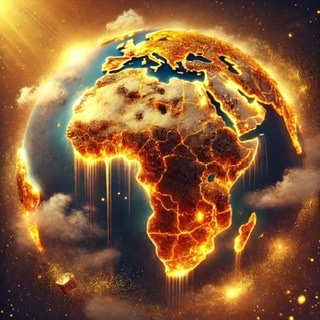
There was a time, not so long ago, when the white sat in Berlin as cartographers and sketched our noble continent, Africa, not in political colours but into commodities to their own benefits. The Ivory Coast, the slave coast, and the Gold coast. They were not names the continent gave itself, but they marked the era Africa entered the world stage not as place, but a source where lot of resources could be used to feed European factories.
That habit that Africa sit on a large deposit of minerals has never quite died. We still speak of nations by what lies underneath their soil. And if you listen to the litany of their description you would wonder you were reading the fountain of a divine treasury.
Egypt “Kingdom of long-staple cotton” thread that once clothed the empires of the Nile with it silky fibres. Egypt’s year round moderate climate is perfect for cotton plantation and gives it a superior quality.
Morocco sits upon a chemical throne. The “Phosphate kingdom” keeps three quarters of the world’s rock phosphate. The world’s biggest known home of deposits of phosphate, controls 70 percent of the world’s phosphate reserves.
Guinea , a country that does not mine bauxite; it is literally bauxite on it own, refered to as the “Bauxite kingdom” the country controls about one-third of the world’s bauxite reserves.
Zambia the copper nation with about 90 percent of export to other countries.
South Africa wears the title “Gold kingdom” for over a century not until recently Ghana surpassed them in gold producing.
Nigeria, the “African oil Giant” producing crude oil from the Niger Delta basin. The country has a pervasive reserve of natural gas ,oil, and petroleum.
The Democratic Republic of the Congo, once the Zaire, once the “Gem of the Central Africa” holds the world’s largest deposits of industrial diamonds , buried in a soil that has known more sorrow than celebration since the time of it independence till now.
Tanzania, “the land of Sisal and Cloves”, her islands fragrant with a spice that once perfumed Zanzibar’s ancient trade winds.
Senegal, “Groundnut Nation”, where the groundnut oil flows, and where per capita production of the humble legume remains the highest on earth.
Gabon, the “Forest kingdom”, wears a cloak of green forest, the highest canopy coverage in Africa.
Ghana, the “Cocoa kingdom”, also known as the gold coast for it richness in the possession of gold, taught Africa how to ferment the cocoa bean. Through her throne has slipped , the aroma of her harvest still lingers in every chocolate bar.
Algeria harvest esparto grass across the high plains, and for that, it is the “Alpha Grass Kingdom” a crown of fibre and paper.
Lesotho, high in the sky of the south, known as the “Switzerland of Africa”, not for banks, but for its beauty.
Botswana, the cattle nation where prosperity once walked on four legs.
Liberia guards the gate, they call it the “West African Doorway” and the “Maritime Kingdo”, its flagged ships a ghost navy sailing every ocean.
Burundi, the “Heart of Africa “, This goes beyond simple cartographic interest. Nestled between Tanzania and the Democratic Republic of the Congo, Burundi is shaped eerily like the human heart on the continent's map.
Libya, the “Desert Kingdom “ Spreading across the nation, it is a silent golden tyrant that determines where rivers should flow and where cities can breathe. It is a place where the sand does not just leave; it rules.
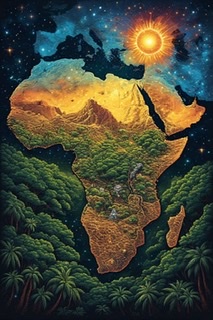
In spite of all the natural resources that the continent holds, the phosphate, the gold , the copper , Diamond, oil, and the cocoa. Africa still arrive on an account that makes no sense by every law of economics and accounting. All things being equal Africa should not be on the the path it is on presently. In the midst of all this resources available and the chaos the continent finds itself, Ali Mazrui put forward a question “Why is Africa , the most resource-rich continent, but remains the poorest?
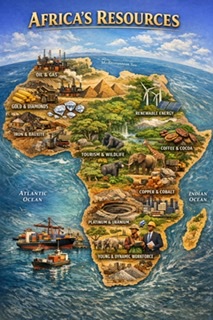
We find ourselves in a wonderland that of all the divine blessings from above Africa still lacks behind.
Ali Mazrui’s question still hangs in the air like smoke from a dying fire.
Mazrui’s paradox is not just an observation of poverty: it is an indictment of a world order. Africa holds of about 60 percent of the world’s gold reserves, yet her people walk on floors of bare earth. She holds the world’s largest gold reserves, diamond, and phosphate, yet her children go hungry. The Democratic Republic of Congo , the “Gem of Central Africa” is ranked 171st of 193 nations in the Human Development Index rankings of the the 2025 - the second poorest country on the face of the earth. Africa is rich in terms of resources but it people are poor.
We have told that resources make nations rich, but Africa stands before history as the living refutation of that lie. The grounds of the oldest civilisation, yet drawn as the youngest on the map of power.
Ali Mazrui does not put forth this paradox and question to shame the continent; it is a wound to be examined and treated and the examination and treatment must begin with the names we give to ourselves-Gold Coast, Ivory Coast , and what are few-and the somnolent silence between what the names we refer to the various countries of Africa promises and what they actually deliver.
The greatest contradiction in Africa is that the continent's unparalleled wealth in natural resources is always juxtaposed with the terrible material circumstances of its citizens, resulting in the majority of Africans living in poverty.
References
Ali Mazrui, (The African Condition).
HDI Rankings, (2025)
Sage Journal Article, (2024).
Battery swap cabinet article, (2025).
Archeology.org, (2004)
EAC. Int . ACCORD speech, (2006).
Anglican Journal travelogue.